Terroir on the Tracks
In this penultimate section, I will highlight the “slow” concepts of ekiben that are juxtaposed with fast-paced culture of transnational train travel. Japan’s sense of place is strong: In Japanese scholarship, ekiben are often discussed and organized by geographical regions, and almost every train station is famous for a regional specialty, always expected to include local ingredients (Noguchi 1994: 323). In no other place can you whip by rice fields and rivers at 200 miles an hour, while consuming the bounty of the landscape in which you see.
The taste and place of ekiben implicates a distinct set of simultaneous agricultural and industrial food practices driven by Japan’s devotion to “shun,” seasonality, and local tourism. “Local practices do affect our physiological taste experiences, but particular stories show that the different emphasis placed upon terroir and the acclaim awarded to it also depend, above all, on how much tasting terroir matters to everyone involved in farming, cooking, eating, and drinking” (Trubek 2008: 245). Whereas American fast food encompasses uniformity and cost efficiency, the Japanese “put value on local variations” (Noguchi 323). Here’s how.
The “Shun” of it All
The forefront of Japanese gastronomy and foodways are elements of taste, cooking techniques, and the aesthetics of “shun,” or cooking with seasonal ingredients that their peak flavor and freshness (Seligman 1994: 165). What is packed in one’s ekiben is inherently seasonal and purposeful: “The bamboo shoots of spring, the eggplants of summer, the matsutake mushrooms of early autumn, and the white daikon radish of winter are best when in season. Harmony of taste and texture, season, and presentation is integral to Japanese cuisine,” writes Seligman (166).
Japanese communities and agricultural systems do not delimit food to geography. Food is earth and earth is food. For every ingredient, there is a season in which it tastes best (Noguchi 1994: 321). Seasonal foods are fleeting and in Japan, they usually will not follow the methods of a global supply chain. This applies to anthropologist and food scientist Amy Trubek’s framework theories on terroir and “taste of place.” Trubek acknowledges that utilizing taste of place to intervene into a global trade net offers economic and cultural possibilities, but also encourages local agriculturalists to compete against global market systems (2008: 207).
Noguchi uses Hiroshima’s Mihara Station to explore the ekiben seasonal calendar: In the winter, kaki meshi (oyster rice) is sold; when spring arrives, tako meshi (octopus rice) is swapped in; summer is all about anago meshi (conger eel); and autumn focuses on mushroom matsutake (ibid: 322). Even the rice changes as the four seasons come and go. While this ekiben is sold under one name—“Za Ekiben”—throughout the year, its contents are changing (Figure 3.1). Just like nature. A sort of respect, reflection, and honor is practiced here, and the careful organization, packaging, and ingredient assortment of ekiben act as tangible proof.
One Village, One Product
Of the few Western ekiben-based texts I found to supplement my research, Hashimoto and Telfer were the only authors to reference the One Village One Product (OVOP) movement of the late 1970s. They argue the success of the ekiben is inevitably linked to the regional improvement efforts of this policy. OVOP kickstarted in Oita Prefecture, where remote rural villages once devastated by post-war devastation would focus on, and become known for, one type of agricultural product (2019: 106; Figure 3.2). The authors found pointed to Ōyama, a town that pivoted from low-yield rice cultivation to high margins of umeboshi, chestnuts, and cherry orchards as an example. Their ability to pivot was thanks to investment in the youth and farming community; Ōyama sent citizens abroad to learn new agricultural practices (ibid). Other famous OVOPs today, which are seen in ekiben delicacies, include Hokkaido scallops, paper lanterns of Odawara, small seabream from Katamachi, and Nara persimmons (Kamekura et al. 1989). Heritage artifacts, intangible culture, or other distinguishable items could also be used to uplift tourism and capital in rural communities.
In a similar fashion, ekiben are known for place-based ingredients from a station’s town. The regionality of ekiben was found to promote food tourism and agriculture, as travelers are able to sample local products in season and eat regional dishes otherwise inaccessible. Like OVOPs, ekiben sells a regional product—but it can do so on the move and beyond physical bounds. A Japanese commuter or American tourist can fall in love with ezo wappa (rice topped with scallops, sea urchin, crab and roe fished in the Sea of Japan) from Asahikawa without ever stepping off the platform (Figure 3.3). “What is unique about ekiben, is that travellers do not have to go to a specific tourist attraction to enjoy the culinary attributes of a region; the experience is gained through food consumption while gazing at the landscape through the train window” (Hashimoto and Telfer 120). In some cases, corporate restrictions require specific trains to only allow ekiben from the region it is passing through on board. Some sectors of the Japanese government have enacted the inclusion of local food tourism in regulatory frameworks (ibid: 115).
Ekiben is inexplicably intertwined with regional identity—it goes way beyond a national culture. Selling ekiben as tokens of regional wares allows consumers to 1) understand OVOPs are “from a real place, made up of real people doing real work, not a living museum,” 2) appreciate that prefectorial sense of place is on equal ground with a sense of well-being, and 3) see how food and people are connected through a distinct place (Trubek 215). In fact, a 2011 food survey showed participants ranked historical ekiben, and those with regional ties ranked the highest (Nippon.com 2011; Hashimoto and Telfer 115). Ekiben marketers have increasingly pushed ekiben’s slow-food appeal: Campaigns focus on farming methods, preparation processes, safe and traceable food ingredients, and the promise of a nutritious meal (Hashimoto and Telfer 116).
This trend has not gone unnoticed. In addition to their annual festivals, Japan Railway even publishes ekiben guidebooks that list the names and ingredients of limited bentos from train stations across the country (Kamekura et al. 5). Nippon Hōsō Kyōkai (NHK), Japan’s leading public broadcasting system, has aired multiple series—in Japanese and English—about the regionality of ekiben. Hosts will travel throughout Japan, via train of course, and meet with the artisans, farmers, fishermen, butchers, and restaurant owners behind the local ingredients of ekiben (Figure 3.4).
An initiative to register ekiben as an intangible cultural asset of Japan was proposed in 2023. Yoshifumi Okuyama, a section chief in West Japan Railway Company’s culture promotion department, is leading the effort because “ekiben that offer local specialties are a culture, while convenience stores that provide uniformly tasty bento across the country are a civilization,” he said in an interview with Kyodo News (Koshika 2025; Figure 3.5 ). Okuyama believes ekiben have maintained their flavors and cooking methods, even as Japan modernizes and traditional dishes are no longer prepared at home. “Ekiben can be considered a railway asset, and I will pass them on to the next generation,” he added (ibid). Japan’s Cultural Affairs Agency endorsed this project in the 2024 fiscal year.
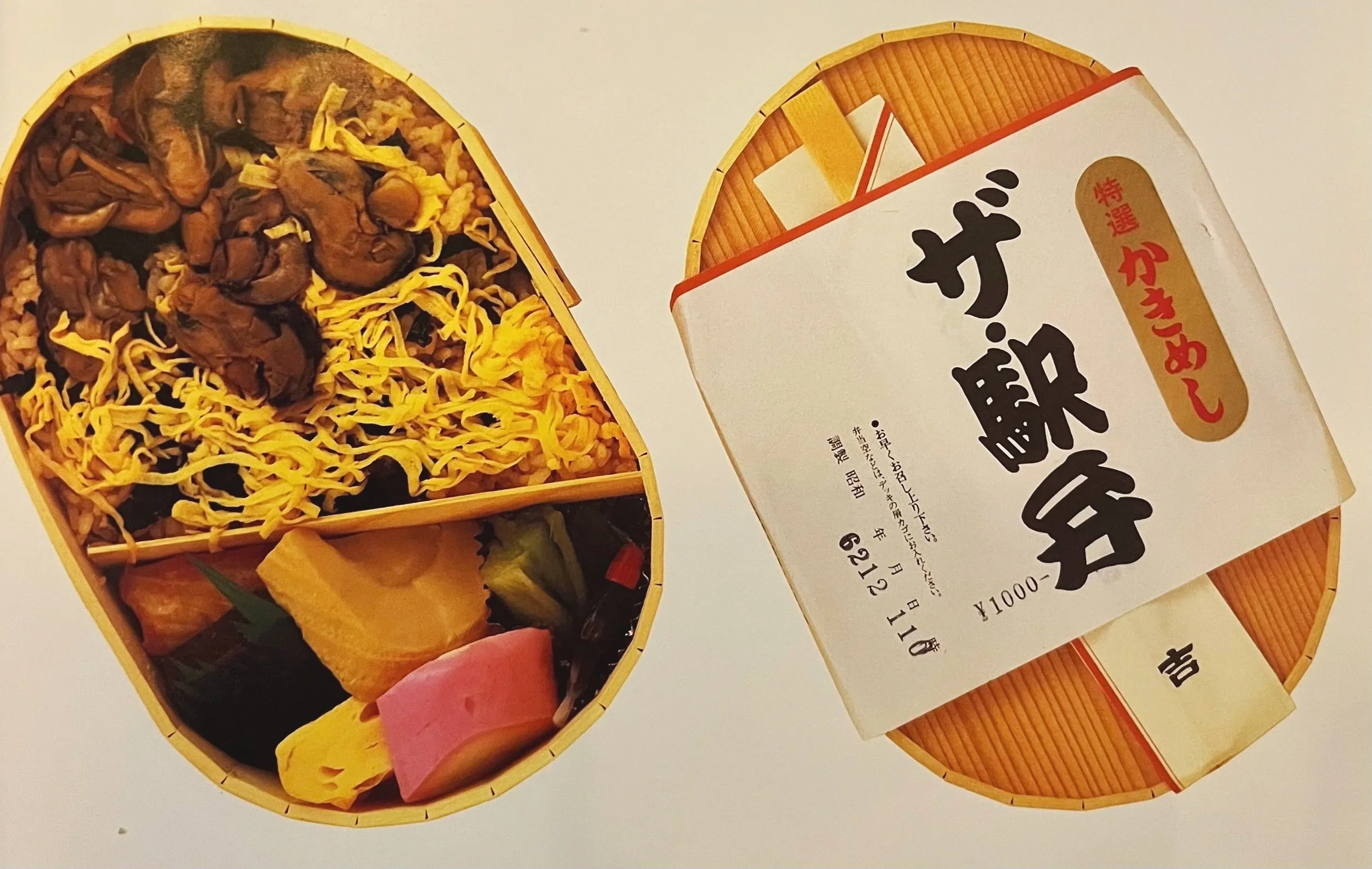
Figure 3.1 The menu of this Za Ekiben changes according to season. Photo by Masaru Mera, accessed by Kamekura et al. (1989: 97).
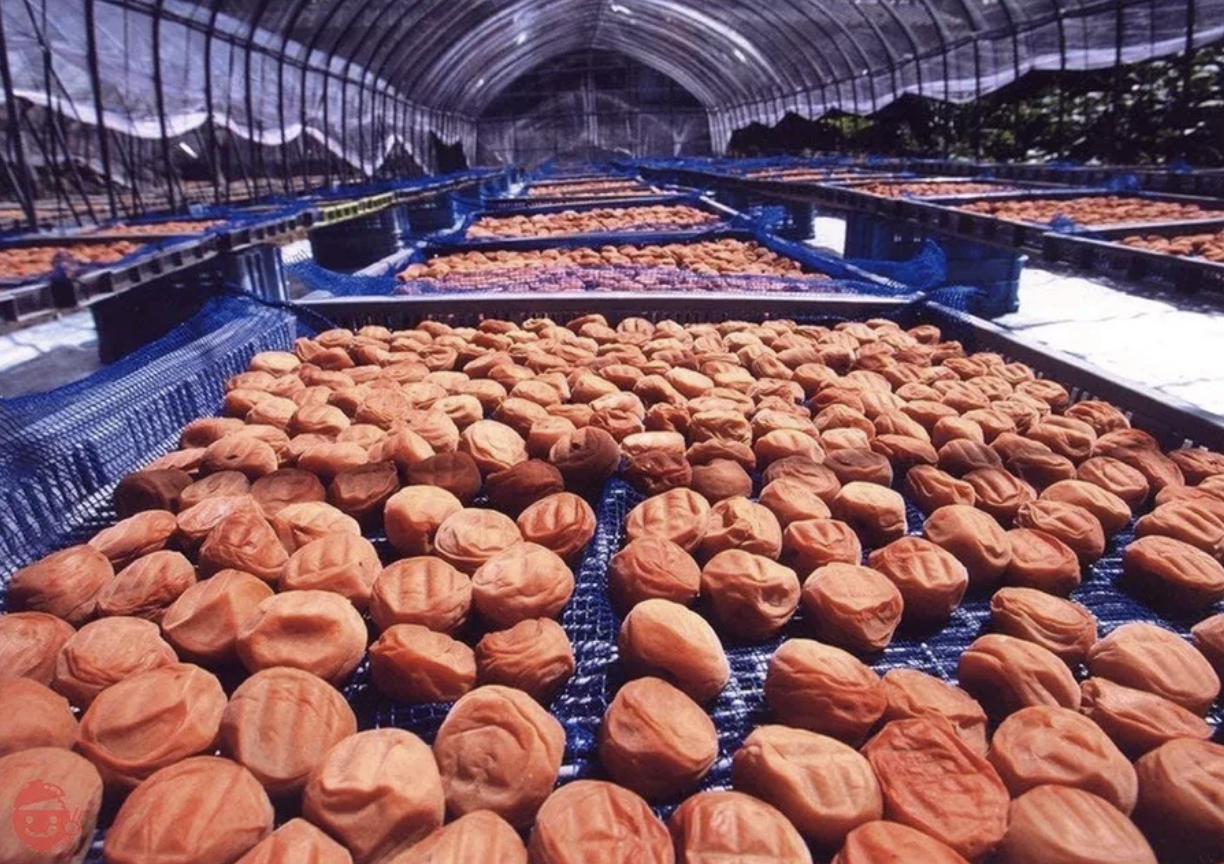
Figure 3.2 Pickled plums (umeboshi) at a farm in Ōyama. Photo courtesy of Japanese Taste.
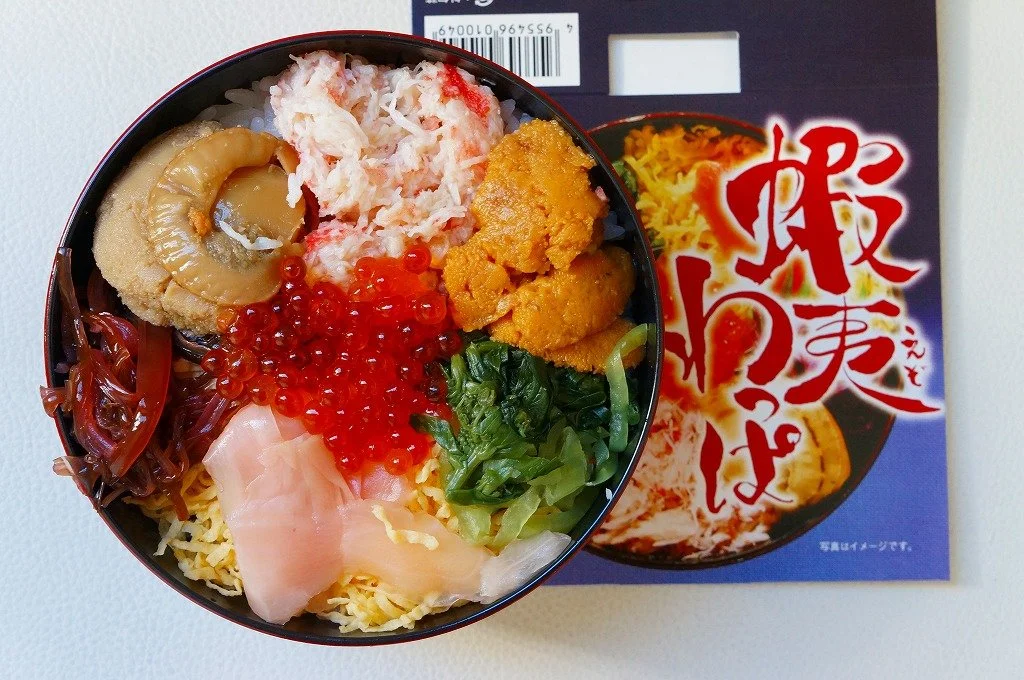
Figure 3.3 Ezo wappa ekiben at stations in Asahikawa, Hokkaido. Photo courtesy of the online Ekiben Museum.
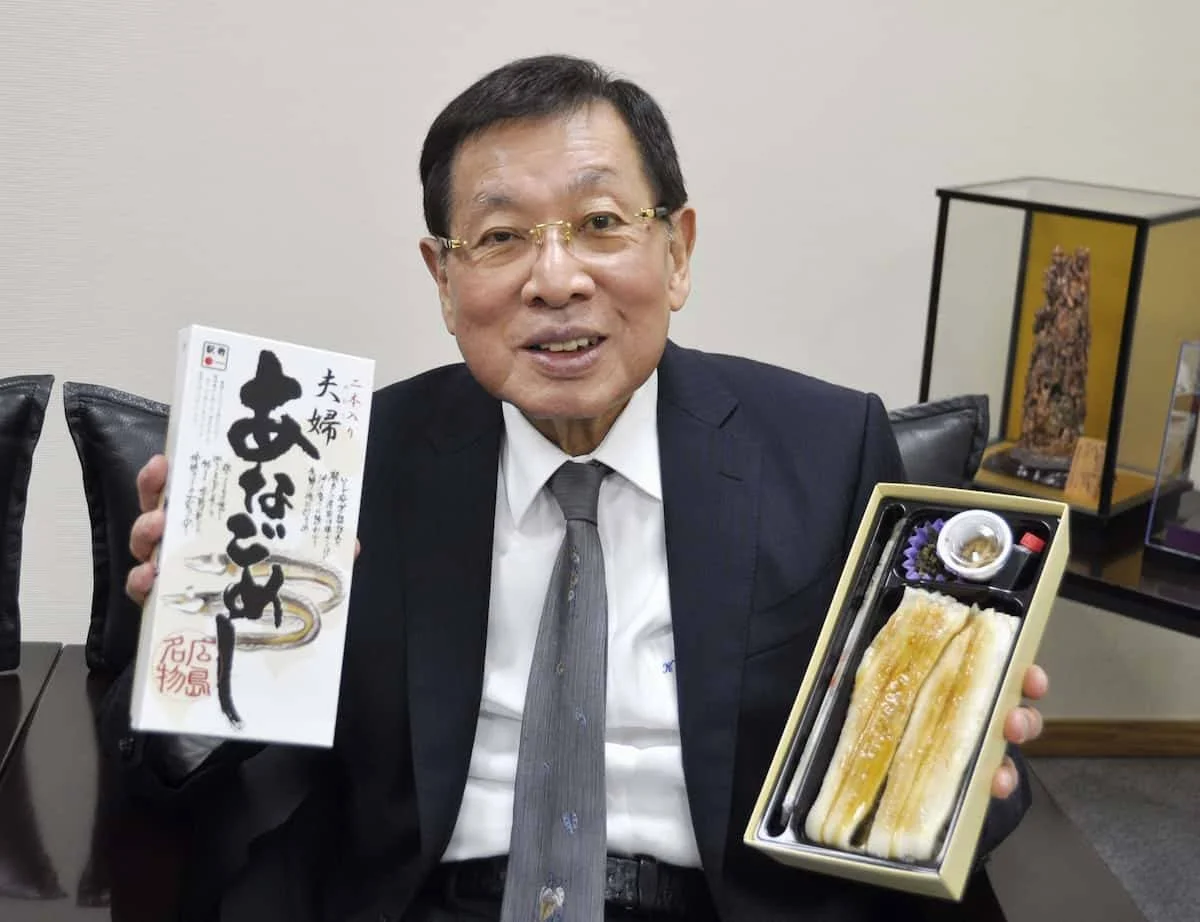
Figure 3.5 Kazuo Nakajima, representative of Hiroshima Ekibento, holding meoto anago meshi (couple’s conger eel rice). Photo courtesy of the Sankei Shimbun, accessed by Japan Forward.
Let’s Go Ekibenning!
Nicknamed the “Ekiben Queen,” Shinobu Kobayashi helped guide me through regional ekiben styles found in Japan. Over the last 40 years, she has traveled around Japan just to eat seasonal and limited-edition ekiben; she will purchase multiple boxes from one station (so she can try as much as possible) and feels excitement before opening each one as they are “different and particular to the area” (Hani 2003). This aligns with Noguchi’s argument about how eating locally grown or harvested foods while traveling helps one experience a unique appreciation of communion with the area (1994: 323).
Kobayashi’s 2022 lecture with the Japan Foundation in Los Angeles—where she shared the history, diversity, and tastes of her favorite ekiben—mentions about 3,500–4,000 ekiben varieties exist today. (To avoid academic redundancy, watch her talk for native contextualization of how ekiben embodies the taste of place.) Kamekura et al.’s photo essay only highlights about 150 styles. In 2003, TheJapan Times even reported a dozen ekiben were created to commemorate a new shinkansen line alone (ibid). She shared some data about regional options, reported by Yoko Hani of The Japan Times:
“In her years of ekibenning, Kobayashi has also come across some interesting facts and figures, including that JR Tokyo Station sells the most varieties—topping 90 on most days, including some popular varieties from other stations it serves. Meanwhile, the second biggest selection is found at JR Sendai Station, which typically offers around 60 varieties. As regards price, the average bento is around 700-800 yen, though perhaps one of the most expensive is the 10,000-yen ekiben sold at JR Kanazawa Station. This double-decker box meal includes an assortment of dishes that looks like New Year’s osechi-ryori, which is cooked only to advance order by a local top-notch Japanese restaurant” (2003).
According to Noguchi and Matsumoto in the earlier section, one of the former joys of country travel in Japan was to lean out the window and buy an ekiben wholly unique to the area (ibid; 2000: 73). Therefore, I would like the photos below to act as both a digital menu (just imagine picking one up and eating it!) and curated gallery. Why simply write out ekiben styles when I can show you? Also: Hashimoto and Telfer also underline the importance of photographic documentation of ekiben kiosks: the visual data is used to note regional differences and the evolution of the product, thus helping scholars infer on a social practice shaped by the intentions of its creators (104).
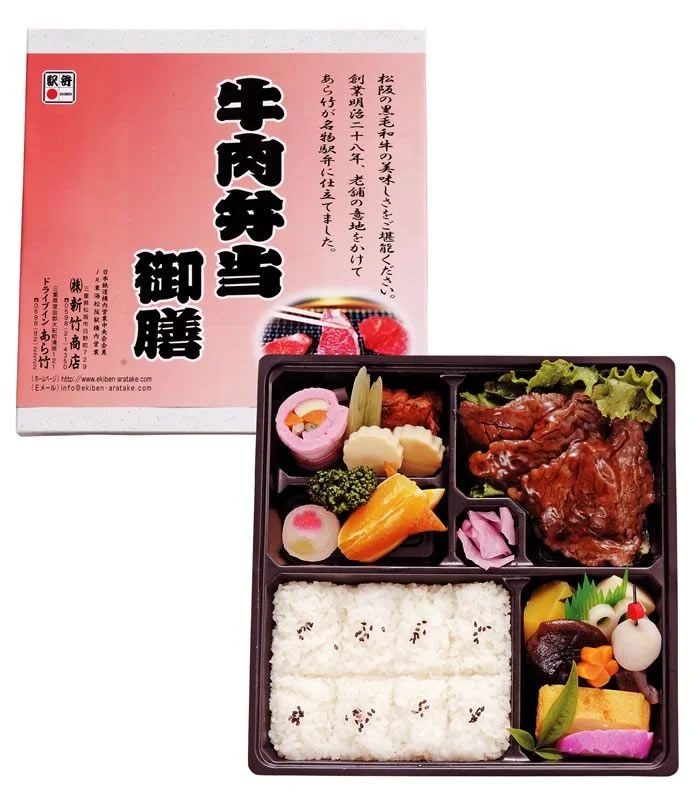
Gyuniku bentō gozen (beef bento tray) from Matsusaka Station in Mie Prefecture. Matsusaka is renowned for its black beef production. Photo courtesy of producer Aratake Shoten Co., accessed by Nippon.com (2011).

Clams and corn rice ekiben from Tokyo Station. It contains sticky rice with local clams and ginger simmered in miso, plus skewered meatballs, eggplant, konjac, egg omelet, kamaboko, and more. Photo courtesy of Online Ekiben Museum (2025).
Ekibento Buffet
A dozen regional styles of ekiben—featuring a range of OVOP food items—found at train stations throughout Japan.
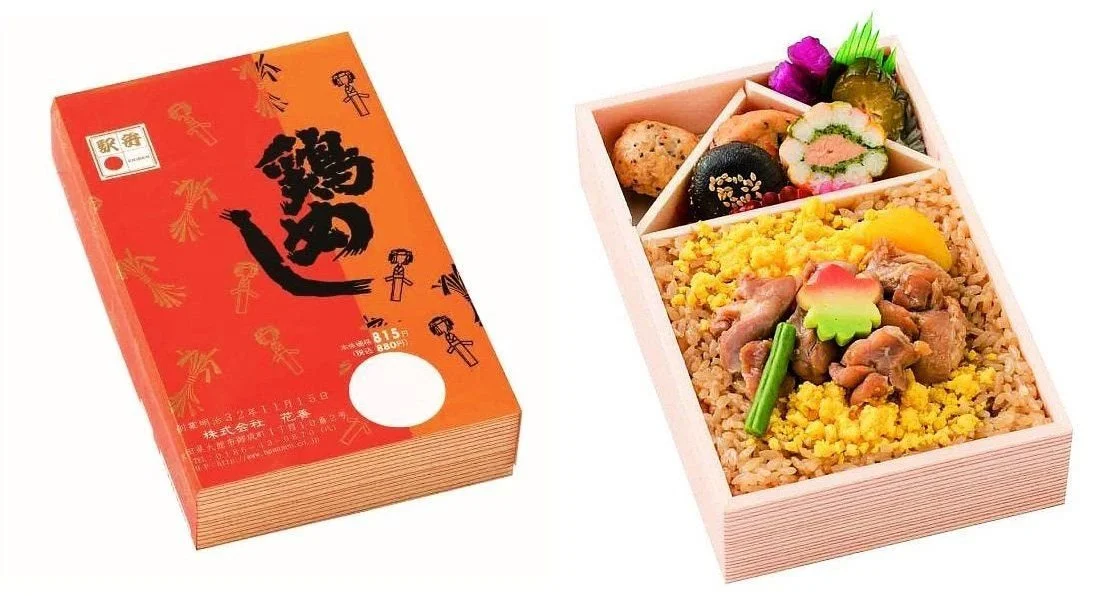
Tori-meshi (chicken on rice) from Odate Station in Akita Prefecture. Odate is renowned for its chicken and local Akita komachi rice production. Photo courtesy of producer JR East, accessed by Nippon.com (2024).
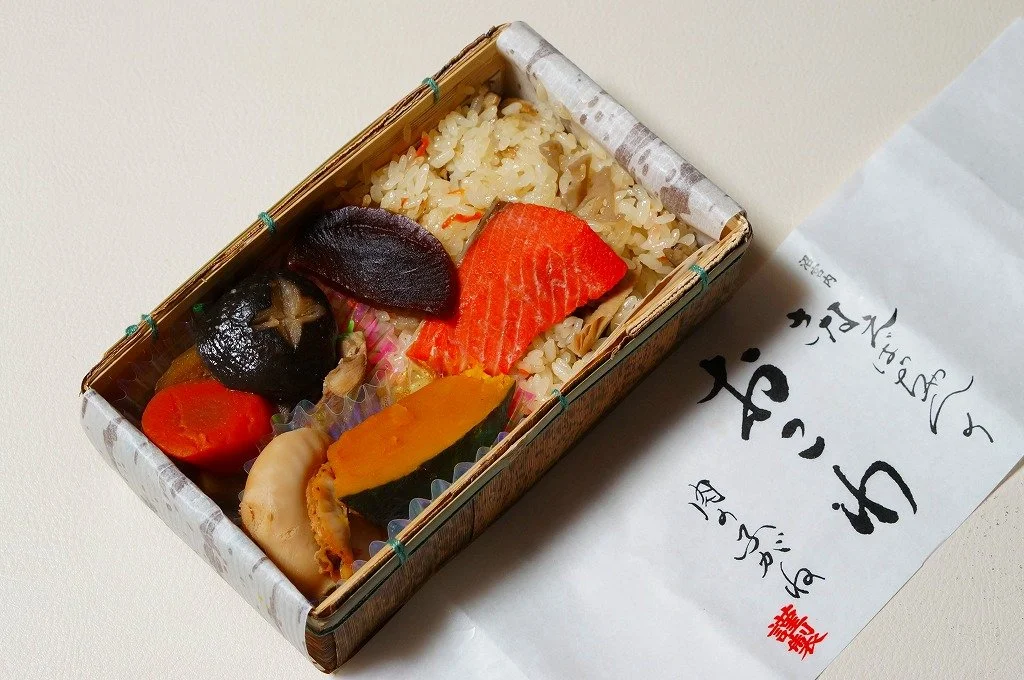
Sanae bacchan’s okowa from Iwate-Numakunai Station in Iwate Prefecture. It contains a local bamboo leaf container filled with grilled and salted salmon, shiitake, pumpkin, and more. Photo courtesy of Online Ekiben Museum (2015).

Suwa-ben hoijanee (“see you again” bento) from Kami-Suwa Station in Nagano Prefecture. The ekiben features local dishes, like Suwa-style dumplings, freshwater smelt, Shinsu pork and appples, and Suwa miso. Photo courtesy of producer JR East, accessed by Nippon.com (2024).
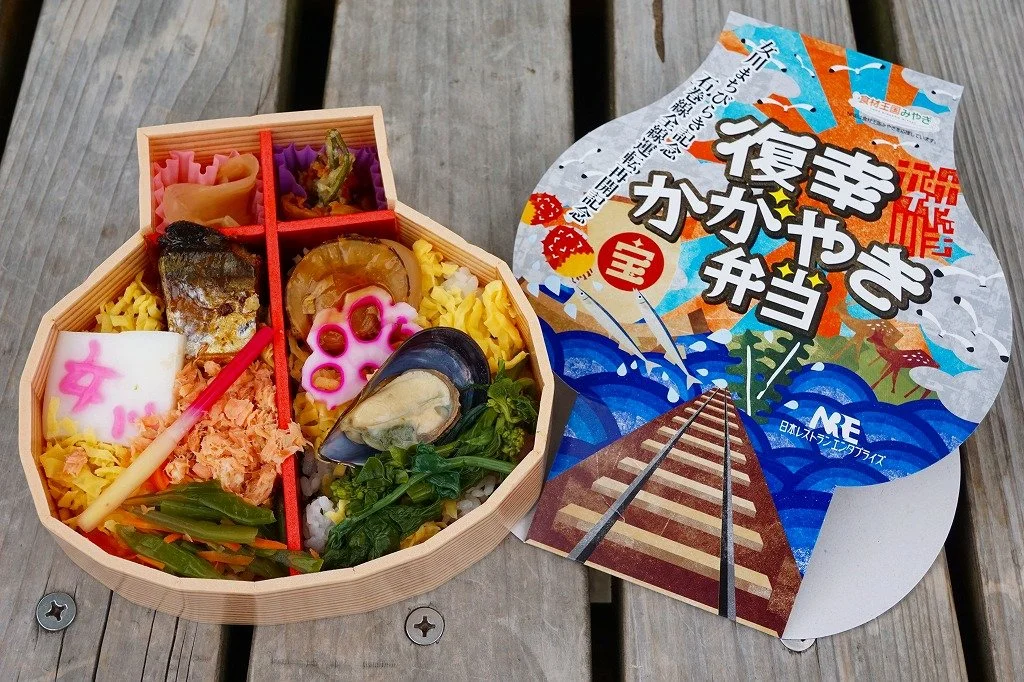
Fukko kagayaki bento from Ishinomaki Station in Miyagi Prefecture. It was sold to commemorate the reopening of the JR Ishinomaki Line after the 2011 earthquake. The scallop-shaped box contains Onagawa sea squirts, saury, scallops, mussels, and fish cakes from five local suppliers. Photo courtesy of Online Ekiben Museum (2015).
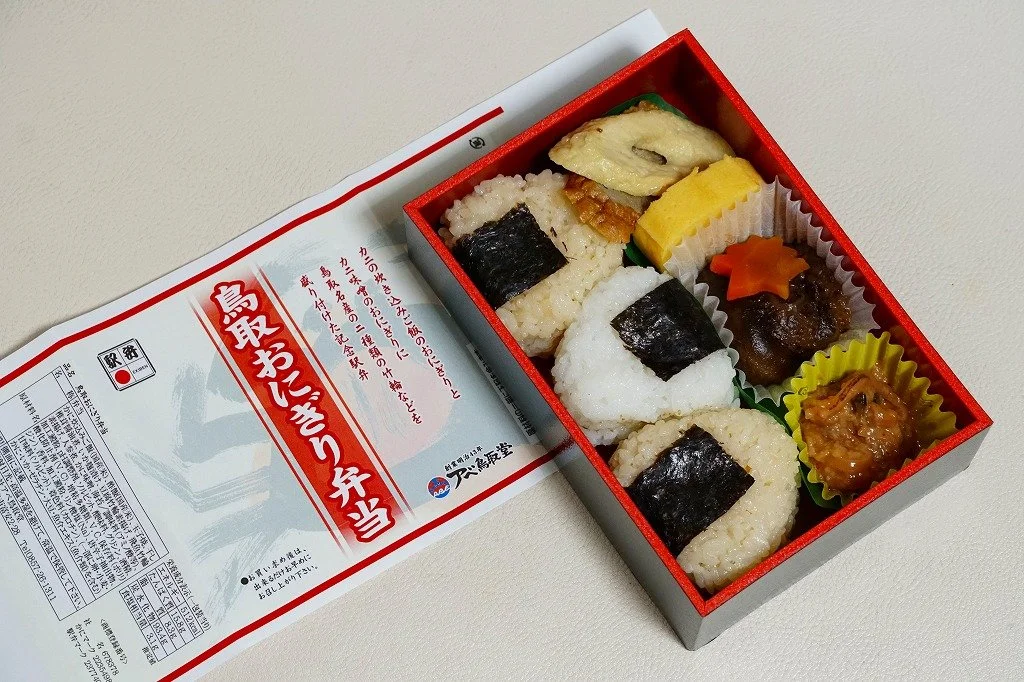
Abe Tottori-do onigiri from Tokyo Station. It was sold to commemorate the 135th anniversary of ekiben–all 47 prefectures had regional ekibens available at fairs, department stores, and select shops. This was a Tottori-style box with local crab rice, pickled squid, deep-fried tofu, and flying fish. Photo courtesy of Online Ekiben Museum (2022).

Shamoji kakimeshi from Hiroshima Station in Hiroshima Prefecture. Inside the exclusive rice paddle-shaped container, you’ll find boiled, fried, and dressed oysters from Hiroshima Bay, dried sardines, and Hiroshima-style green pickles. It is only sold in the winter. Photo courtesy of Online Ekiben Museum (2009).
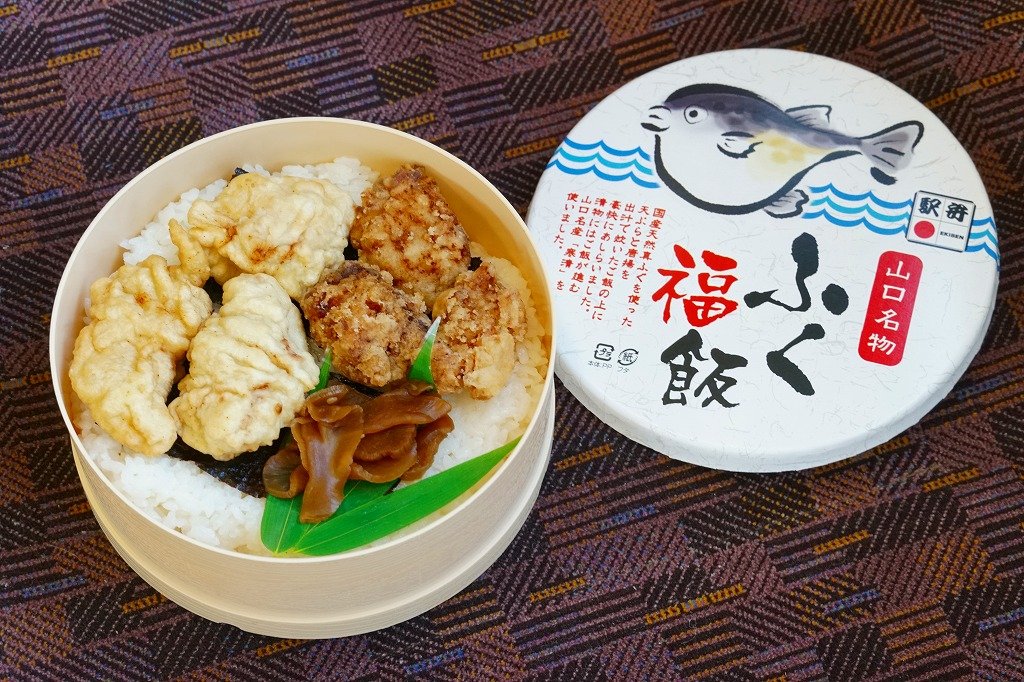
Fuku fuku meshi from Hanshin Department Store in Osaka, inspired by Shimonoseki Station’s fugu sushi bento. It contains seasoned rice, three pieces of fried pufferfish topped with seaweed and pickles. Photo courtesy of Online Ekiben Museum (2020).
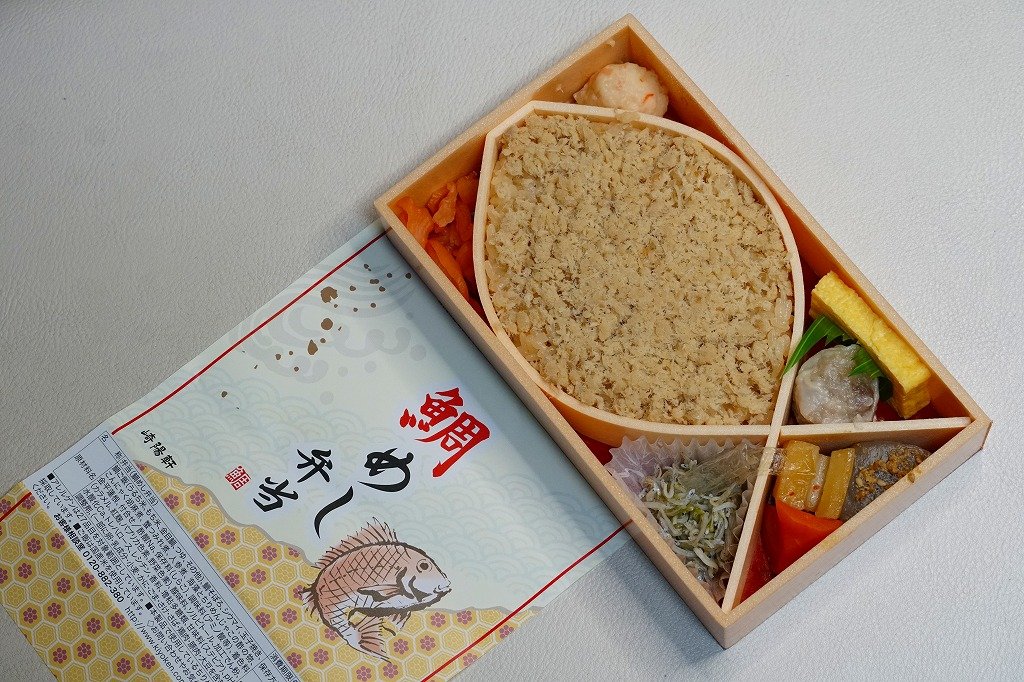
Taimeshi bento from Yokohama Station. With a main compartment mimicking local sea bream, this ekiben contains mixed golden snapper glutinous rice topped with minced sea bream. One corner gap has cherry blossom pickles and shumai, a nod to Yokohama’s large Chinese population and famous shumai stalls in its Chinatown. Photo courtesy of Online Ekiben Museum (2021).
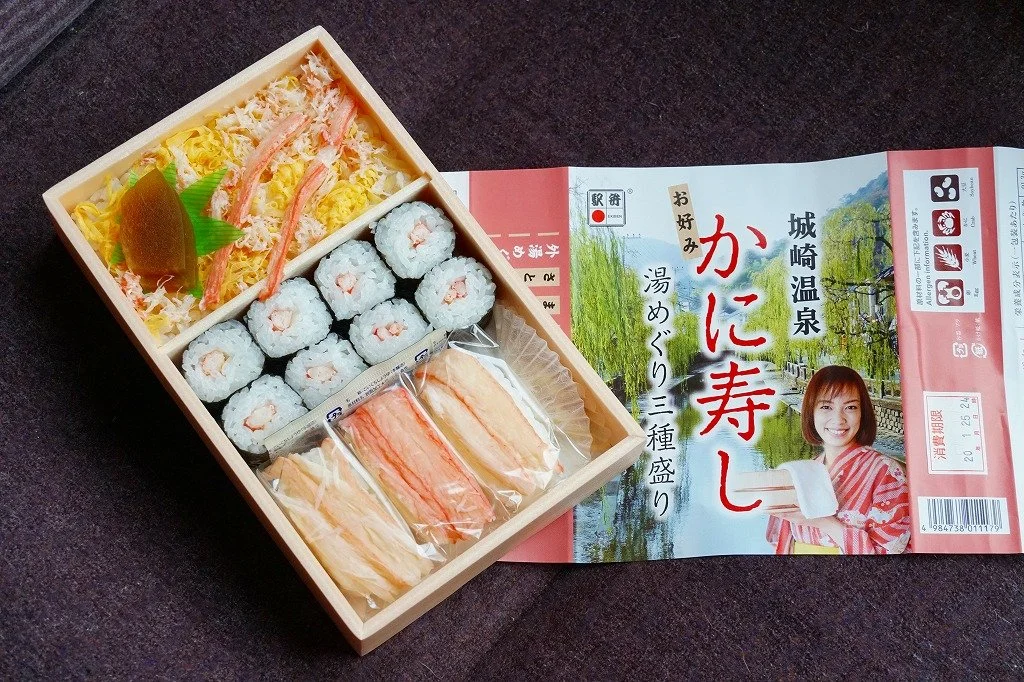
Kinosaki onsen okonomi kanizushi yumeguri sansyumori (assorted crab sushi with hot spring treats) from Kinosaki Onsen Station in Hyōgo Prefecture. To honor Kinosaki’s public bath culture and crabbing heritage, this ekiben has eight thin crab rolls, crab leg rice, and three crab nigiri. The packaging includes a list of Kinosaki’s best onsens. Photo courtesy of Online Ekiben Museum (2020).
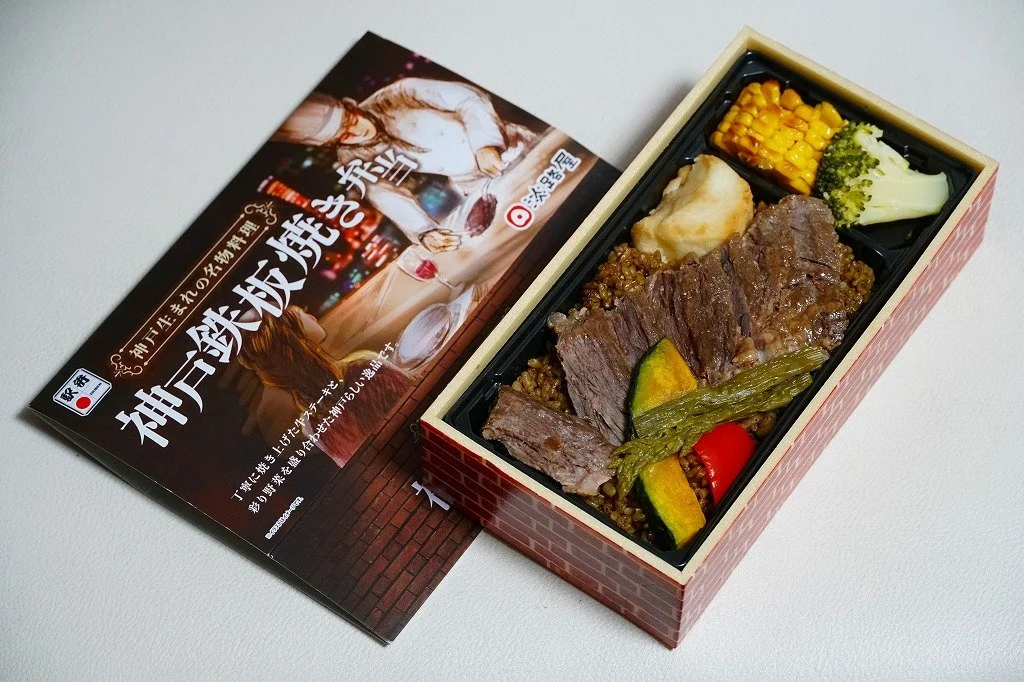
Kobe teppanyaki bento from Keio Department Store in Tokyo, inspired by famous Kobe yakiniku. Black garlic pepper rice is topped with seasoned Kobe beef, and served with potatoes, pumpkin, peppers, asaparagus, and broccoli. Photo courtesy of Online Ekiben Museum (2022).