Why Ekiben?
On a school trip to Akita, one of mainland Japan’s northernmost prefectures, I ate my first-ever ekiben, or train station lunch box.
A group of us were bussed up to Oga City for the annual winter Namahage Sedo Festival, a devilish affair that combines ancient Shinto culture with demon folklore. After the sunset, we were corralled to a crowded field in a mountain basin. Surrounded by yakisoba and takoyaki stalls, groups of people launched gigantic lanterns covered in wishes and good fortunes. Later, in the dead of night with only bonfires to help us see, local men dressed as demons descended from the mountain with torches and drums to ward off evil spirits. Despite the February chill, the atmosphere felt warm, electric, and a tad bit sweaty. The perfect antidote was our resort’s private onsen with steaming spring water. All this goes to say: The only thing I talked about when we returned to Tokyo was the ekiben.
After our date with demons, we explored Oga City’s rocky cliffs along the Sea of Japan, historic samurai culture, and famous train networks that looped through snow-packed valleys. It was on a cute three-car train—one that was pelleted with a wintry mix as it chugged along narrow tracks in forested Akita—where we were handed makunouchi ekiben. Local vegetables and seafood were packed in a geometric container outlined by colorful paper ramekins. A large helping of rice with sesame seeds and umeboshi took center stage. Everything about it screamed meticulous love and regional pride. Each bite was crunchy, fresh, and filling.
I had never experienced something like this—it was mind boggling to be savoring seasonal flavors and ingredients harvested in the very lands we zoomed by. Had American train and plane travel lowered my expectations that much? Was there a Japanese gastronomic culture I had no idea about? (Spoiler: yes.)
After Akita, I found every excuse to wander around Tokyo train stations or book day trips to nearby prefectures in the name of learning more about ekiben. At the busiest of stations—think Shinjuku, Shibuya, and Ikebukero—ekiben shops were bold, loud, and inescapable. Shokuhin sampuru, or plastic food samples, were lined up on the outside of shops with colorful words pointing out their price, contents, and specialties. At smaller stations, like Nara or Kamakura, different bentos were packaged politely and stacked at manned kiosks. Each box held something unique, something that spoke to the agricultural practices of towns, cities, and prefectures. The parallel between slow ekiben and fast life was ever present; twin cultures of food tradition and modern industrialization was emphasized in every container. Whether I was snacking on a shrimp tempura meshi on a shinkansen hurtling past Mount Fuji or slowly picking away at local veggies on a rural railway surrounded by dense forest, the allure of ekiben was strong and obvious. It positioned Japan at the crux of past and present—and this very concept is what I wish to explore in our History of Food final project. The pages that follow place ekiben in the crossroads of the two attributes (heritage and innovation) that make Japan stand out internationally.
On Ekiben Scholarship
No surprise, ekiben is extremely popular in Japan. There is no shortage of photos, television series, journalistic articles, books, and academic scholarship, plus festivals, marketing campaigns, and more. (Visualization is extremely important—I am not discrediting it. The Online Museum of Ekibento, solely run by Japanese “Train Buffs” and ekiben lovers, was a massive help thanks to its digital archive of submitted images of ekiben. Currently, it is home to a collection of 11,700+ ekiben listings and 8,000+ accompanying images.) However, the majority of current research is in Japanese, so the sources and references of my project are based on ideologies and translated information from Western academics. The understandings of the anthropological culture behind Japan’s high-speed train systems and ekiben economy tends to be limited. The most significant study on the history of ekiben—which weaves Japanese industrialization with washoku traditionalism—was that by Paul Noguchi (1994), who built a chronological and conceptual framework on the dish. He explored the history of ekiben and how it adapted alongside post-World War II behaviors, along with the distinct attributes of seasonality, time, pop culture, and terroir. I also utilized the work of Hashimoto and Telfer (2019), which is the most current ekiben-based scholarship I can find. While Hashimoto and Telfer also strongly rely on Noguchi, they turned to autoethnographies, festivals or events, government policies, and journalistic avenues to inject more historical context of ekiben’s regionalism.
The author’s bibliographies often featured foundational works by Japanese scholars, seen below:
Aoki, Eiichi, et al. 2000. A History of Japanese Railways 1872-1999. Tokyo: East Japan Railway Culture Foundation.
Hoshikawa, Takejiro, ed. 2003. ‘Shinkansen Zenshi’ (The Complete History of the Shinkansen). Tokyo: Gakken.
Kosoku Tetsudo Kenkyükai. 2003. Shinkansen: Kosoku Tetsudo no Gijutsu no Subete (Everything about the Technology of High-Speed Railways). Tokyo: Sankaido.
Tanaka, Kakuei. 1972. Nippon Retto Kaizö-ron (Building a New Japan: A Plan for Remodelling the Japanese Archipelago). Tokyo: Nikkan Kogyo Shinbunsha.
Umehara, Jun. 2002. Shinkansen no Nazo to Fushigi (The Mysteries and Riddles of the Shinkansen). Tokyo: Tokyodõ
Hayashi, J.
1988. Kishaben Ekiben Tabi no Aji (The Taste of Travel in Train and Station Box Lunches).
1989. Ekiben Saijiki (Station Box Lunch Almanac). Tokyo.
1991. “Nihon Retto Ekiben Bunpu (The Distribution of Ekiben in the Japanese Archipelago)” in Oishi Ekiben Fudoki (The Cultural Geography of Tasty Station Box Lunches), eds. Kodansha Editors, pp. 134-44.
Oda 1980
“Ekiuri bentō no hensen” (1). Nippon Jōzō Kyōkai Zasshi, 75(1), 35–39.
“Ekiuri bentō no hensen” (2). Nippon Jōzō Kyōkai Zasshi, 75(3), 204–208.
“Ekiuri bentō no hensen” (3). Nippon Jōzō Kyōkai Zasshi, 75(4), 263–268.
My first makunouchi ekiben on the Akita Nairiku Railway in 2019.
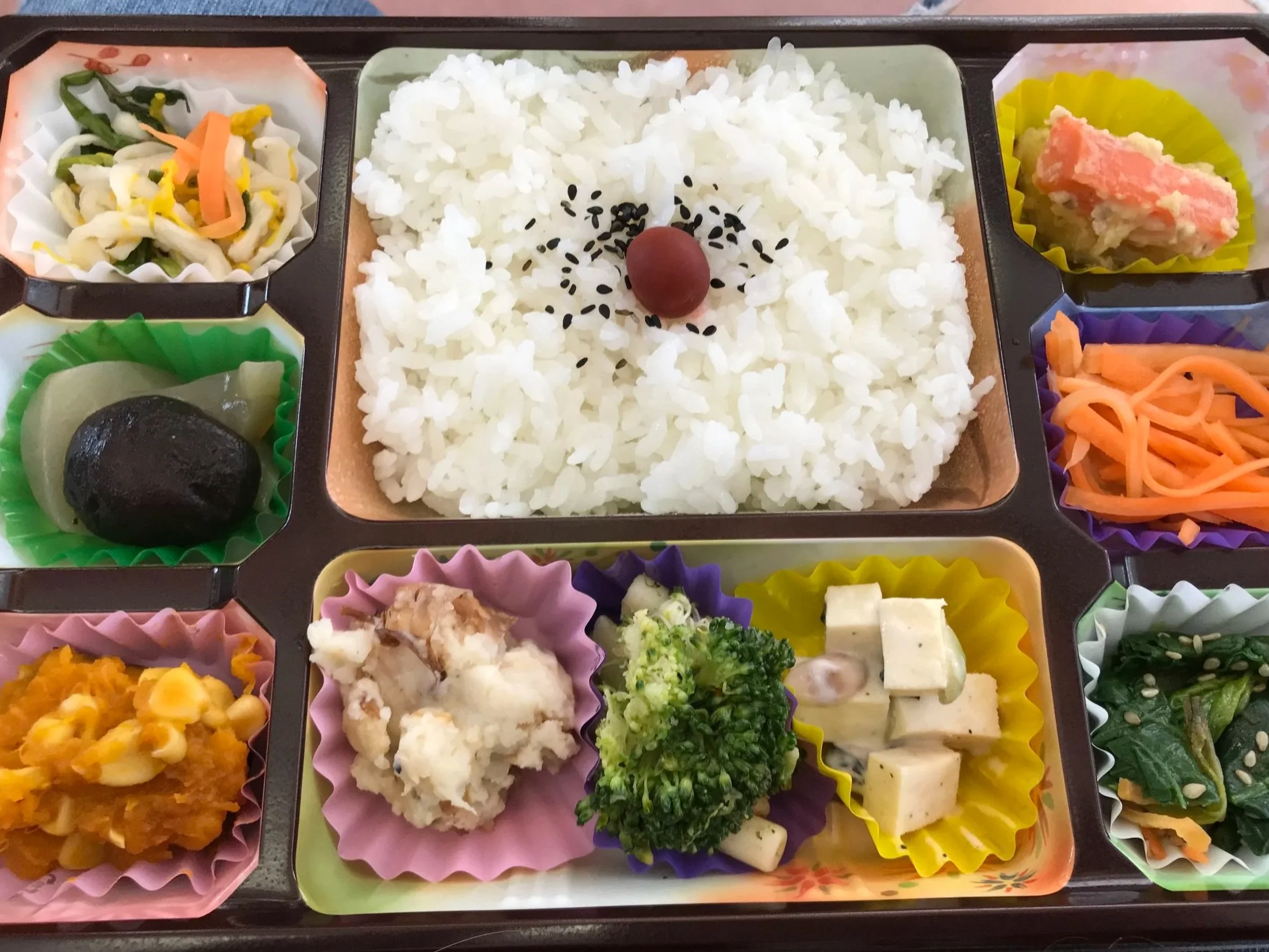
Close-up of the makunouchi bento from Yonzaizawa Station in Kitaakita.
Ebi meshi on the Tokaido Shinkansen between Tokyo and Kyoto in 2019.
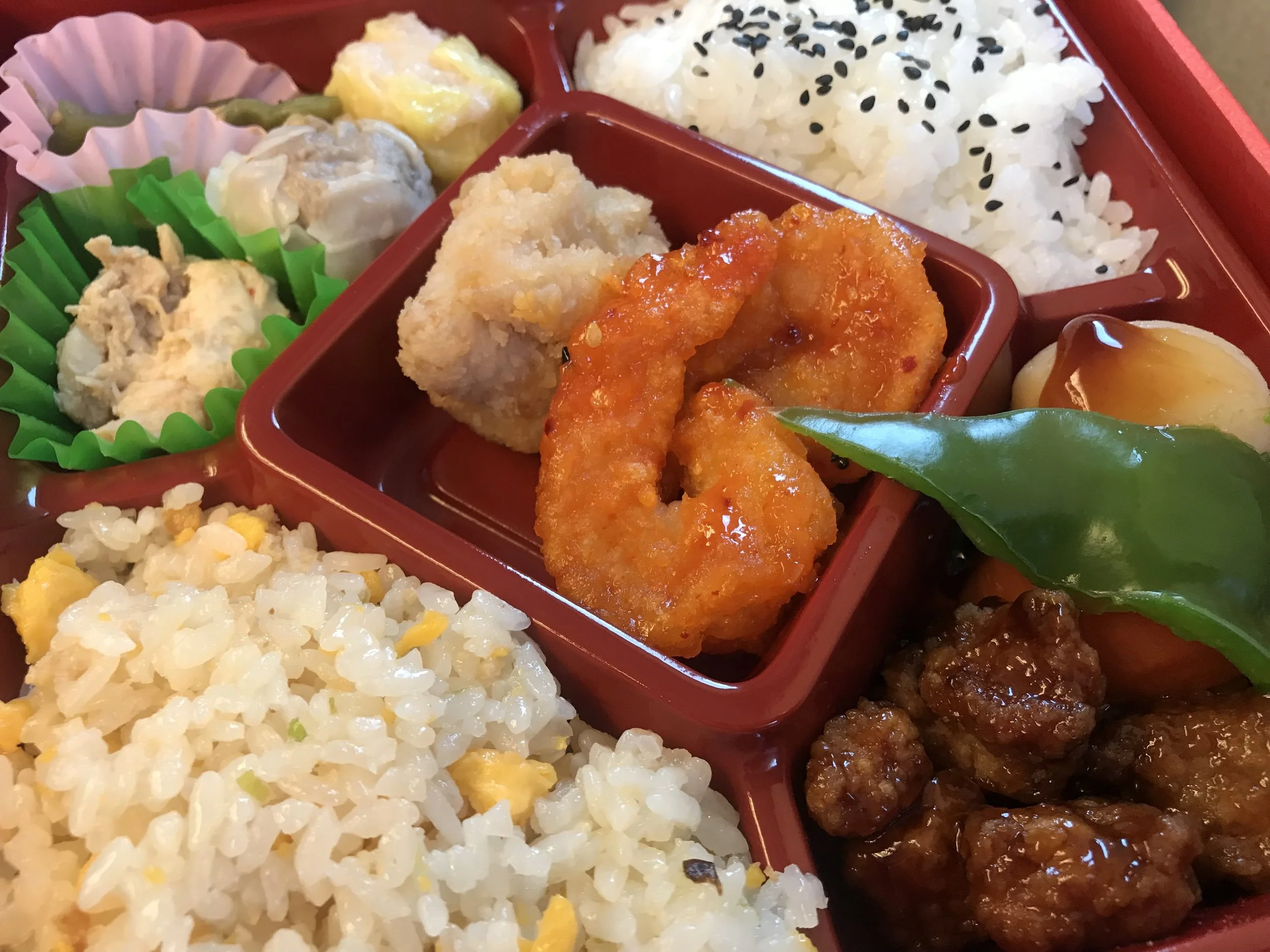
Close-up of the ebi meshi from Tokyo Station.
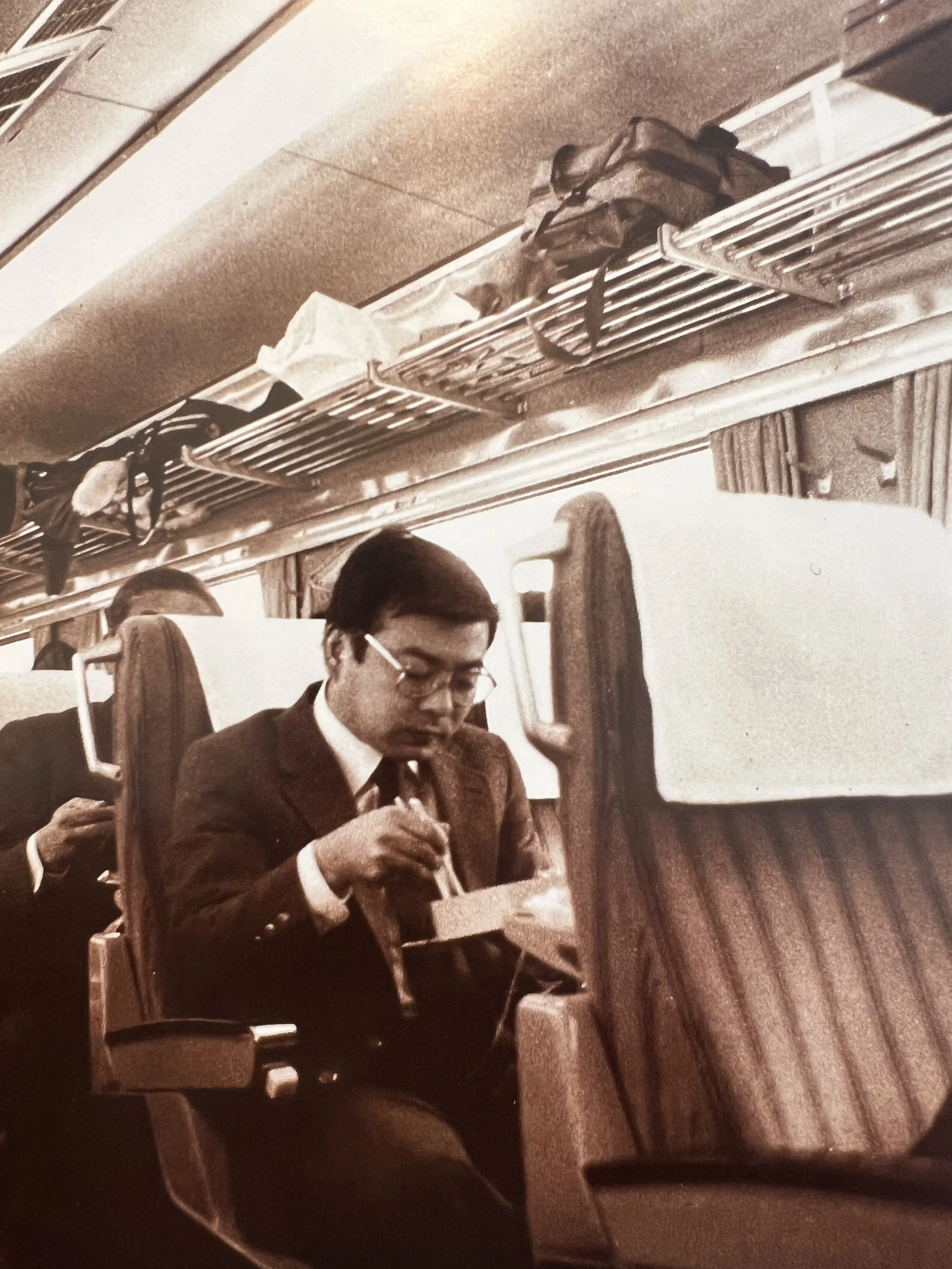
Passenger eating ekiben on the shinkansen in 1989. Photo by Masaru Mera, accessed by Kamekura et al. (1989: 10).
Between 1995 and 2018, when ekiben rapidly expanded and absorbed decades of cultural change of Japan, I found a lack of Western scholarship. Besides Noguchi or Hashimoto and Telfer, there are no anglicized texts focusing on the 3,500+ types of ekiben and what they mean for modern-day Japan. Perhaps it is because scholars think the topic is a vacuum and everything that was needed to be said was said. (I disagree, there is always room to grow.) Perhaps it is because of language barriers or financial accessibility. Perhaps it is because ekiben culture does not translate to American scholars, specifically, in the way it does to Japanese ones. (Can Americans imagine ekiben on Amtrak?) If academia is meant to be a global network of scholars, how can we bridge the gap between multicultural understanding?
I think there is a great deal to be learned by modern-day ekiben and what it means for agriculture and hospitality in the age of environmental crises, foodie-based tourism, and train modernization. Can Western scholars use ekiben to explore a future of building popular transnational railways? How does ekiben apply to the American concept of standardized and homogenous craft-service food? What is the role of the foreign tourist as convenience stores and agricultural jobs fluctuate? What do Japanese travelers think—have we included them beyond surveys and festival voting? Can scholars conduct case-studies on specific Japanese towns and how their tourism, culture, and economy have been impacted by regional ekiben? Food for thought.